Property Buying Process in Sabah 2026: Step-by-Step Timeline Suggested

Once you’ve decided what to buy in Sabah and how to finance it, a separate question takes over: what actually happens between making an offer and getting your keys, and how long does each part take?
This is the practical walkthrough — the sequence of steps, who does what, what you pay at each stage, and a realistic timeline. It assumes you already know what you’re allowed to buy (see our guide to Sabah’s land title system if you haven’t checked that yet) and how you’re financing it (see our Sabah home loan guide). This one is about the process itself, from offer to keys.
| Stage | Who acts | Typical duration |
|---|---|---|
| 1 | Offer & booking | 1–3 days |
| 2 | Letter of Offer / booking fee | Immediate (usually 2–3% of price) |
| 3 | Engage lawyer, due diligence & title search | 1–2 weeks |
| 4 | Sign SPA + pay balance deposit (to 10%) | Within 14–21 days of booking |
| 5 | Loan application & bank valuation | 2–4 weeks (runs in parallel with SPA prep) |
| 6 | State consent application (if foreign buyer or restricted title) | 6–16 weeks |
| 7 | Stamping of SPA, loan agreement, MOT | 2–4 weeks after documents finalised |
| 8 | Loan disbursement | Timed to completion |
| 9 | Completion & registration (MOT) | 2–8 weeks |
| 10 | Keys & handover | On completion |
Total, subsale property, Malaysian buyer, standard title: roughly 3–4 months. Total, foreign buyer or restricted title requiring state consent: roughly 4–7 months, with state consent usually the longest single step.
The rest of this guide walks through each stage in detail.
Stage 1–2: Offer, booking, and the Letter of Offer
Once you’ve found a property, you (often through your agent) submit an offer. If accepted, you sign a Letter of Offer / Booking Form and pay a booking fee, typically 2–3% of the purchase price, to take the property off the market while the SPA is prepared. This fee is usually credited toward your 10% deposit, not an additional cost on top of it.
What to check before signing the booking form: the land title type (Country Lease, Town Lease, Native Title, Field Registrar), whether state consent will be needed, and whether the price and terms match what you actually negotiated verbally. A booking form is a real commitment — don’t treat it as a placeholder.
Stage 3: Engage a lawyer and start due diligence
You’ll need a lawyer regardless of whether the seller has one — your interests aren’t the same. In Sabah, your lawyer’s early-stage work includes:
This typically runs 1–2 weeks and should be substantially done before you sign the SPA, not after.

Stage 4: Sign the Sale and Purchase Agreement (SPA)
The SPA is the binding contract — price, payment schedule, completion timeline, and what happens if either party defaults. For a subsale, expect to pay the balance of your deposit to bring the total to 10% of the purchase price on signing (having already paid 2–3% as the booking fee).
The SPA itself attracts a nominal RM10 stamp duty as a document, separate from the much larger stamp duty payable later on the Memorandum of Transfer.
Completion period: most subsale SPAs in Sabah set a completion long-stop date of 3 months from signing for cash/conventional purchases, extended where financing or state consent is involved — your lawyer should set this realistically rather than using a generic template figure, especially if you’re a foreign buyer waiting on state consent.
Stage 5: Loan application and bank valuation
If you’re financing the purchase, submit your loan application as early as possible — ideally the moment your offer is accepted, running in parallel with SPA preparation rather than after signing. The bank will:
This stage typically takes 2–4 weeks for a standard Malaysian applicant with clean documentation, longer for self-employed applicants or where the bank requests additional income verification. Foreign buyers should confirm upfront which banks will even consider the application — not every bank lends to non-residents, and it’s a wasted 2–3 weeks to find that out after applying.
Stage 6: State Authority consent (if applicable)
This step doesn’t apply to every transaction, but where it does, it’s usually the longest single item on the timeline:
- Every foreign buyer needs written State Authority consent for any Sabah property purchase, processed through the Sabah Land and Survey Department.
- Purchases involving Native Title or restricted land dealings between a native seller and non-native buyer also require Ministerial written permission, separate from the standard registration process.
Stage 7: Stamp duty and legal fees — what you’ll actually pay
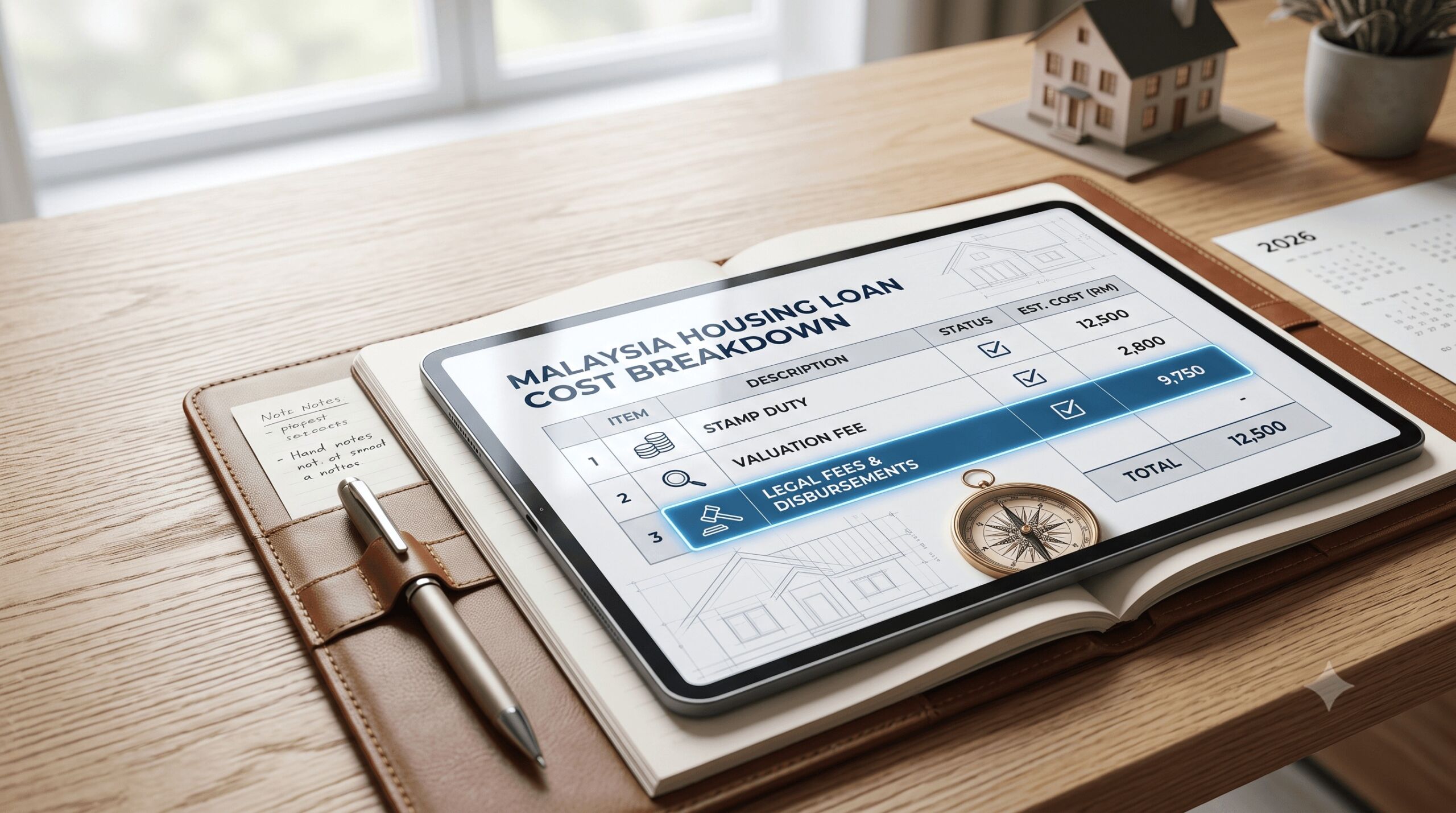
Three separate documents attract stamp duty, and your lawyer’s fees are calculated on a separate regulated scale. Budget for both.
Memorandum of Transfer (MOT) stamp duty, based on the higher of purchase price or bank valuation:
| Portion of Price | Rate (Malaysian Citizens / PRs) |
|---|---|
| First RM100,000 | 1% |
| RM100,001–RM500,000 | 2% |
| RM500,001–RM1,000,000 | 3% |
| Above RM1,000,000 | 4% |
Foreign buyers pay a flat 8% MOT stamp duty on the full property value (effective from 1 January 2026), regardless of price tier.
First-time Malaysian buyer exemption: SPAs signed between 1 January 2026 and 31 December 2027 for properties priced at or below RM500,000 qualify for a full exemption on both MOT and loan agreement stamp duty — a saving that can run over RM11,000 on a typical entry-level Kota Kinabalu unit. Confirm current eligibility with your lawyer, as exemption rules are periodically revised.
Loan agreement stamp duty: a flat 0.5% of the loan amount, unless covered by the first-time buyer exemption above.
Legal fees, regulated under the Solicitors’ Remuneration Order and charged on a tiered scale (indicative — confirm the current schedule with your lawyer):
| Portion of Price | Typical Rate |
|---|---|
| First RM500,000 | ~1% |
| RM500,001–RM1,000,000 | ~0.8% |
| RM1,000,001–RM3,000,000 | ~0.7% |
| Above RM3,000,000 | 0.5%–0.6% |
Legal fees apply separately to the SPA and to the loan agreement (calculated on the loan amount), plus disbursements — title search fees, registration fees, courier and administrative charges — typically a few hundred to low thousands of ringgit on top.
Rough total for a Malaysian buyer: legal fees plus stamp duty plus disbursements commonly land around 4–6% of the property price, on top of your down payment. For a foreign buyer, the flat 8% MOT duty alone pushes total closing costs to roughly 12–15% of the purchase price.
Stage 8–9: Disbursement, completion, and registration
Once the SPA is stamped, the loan agreement is stamped, and (where applicable) state consent is granted, your lawyer coordinates:
Registration timing depends on the Land and Survey Department’s current processing queue — budget 2–8 weeks after all documents and payments are in order.
Stage 10: Keys and handover
For a subsale, handover typically happens at or shortly after completion, once the balance purchase price is released and the seller has vacated. For a new development purchase, this stage is replaced by the developer’s Vacant Possession process and defect liability period, which follows a different timeline set out in the Sale and Purchase Agreement under the Housing Development Act.
If buying strata property, your lawyer or the developer should also hand over Joint Management Body / Management Corporation details — maintenance fee schedule, sinking fund contributions, house rules, and access card procedures.

Document checklist to prepare before you start
Having these ready before you make an offer meaningfully shortens Stages 3–5:
- NRIC / passport copies
- Latest 3 months’ payslips or EA form (salaried) / 2 years’ audited accounts and tax filings (self-employed)
- Latest 6 months’ bank statements
- EPF statement
- CCRIS/CTOS self-check printout
- For foreign buyers: passport, visa/MM2H documentation if applicable, and proof of funds source for anti-money-laundering checks
Common causes of delay in Sabah specifically
- Title type surprises. A property assumed to be standard Country Lease turns out to carry Native Title restrictions, discovered only during the lawyer’s search — always confirm title type before booking, not after.
- Valuation shortfall on subsale property. If the bank values the unit below the agreed price, you need to cover the gap in cash or renegotiate — this can add weeks if it isn’t caught early.
- State consent processing backlogs. This is the step with the widest variance and the least buyer control — build in buffer rather than assuming the fastest-case timeline.
- Incomplete income documentation, particularly for commission-based earners or business owners, stalling the loan approval stage.
- Outstanding charges or arrears on the seller’s side that surface late in due diligence, delaying completion while they’re cleared.